
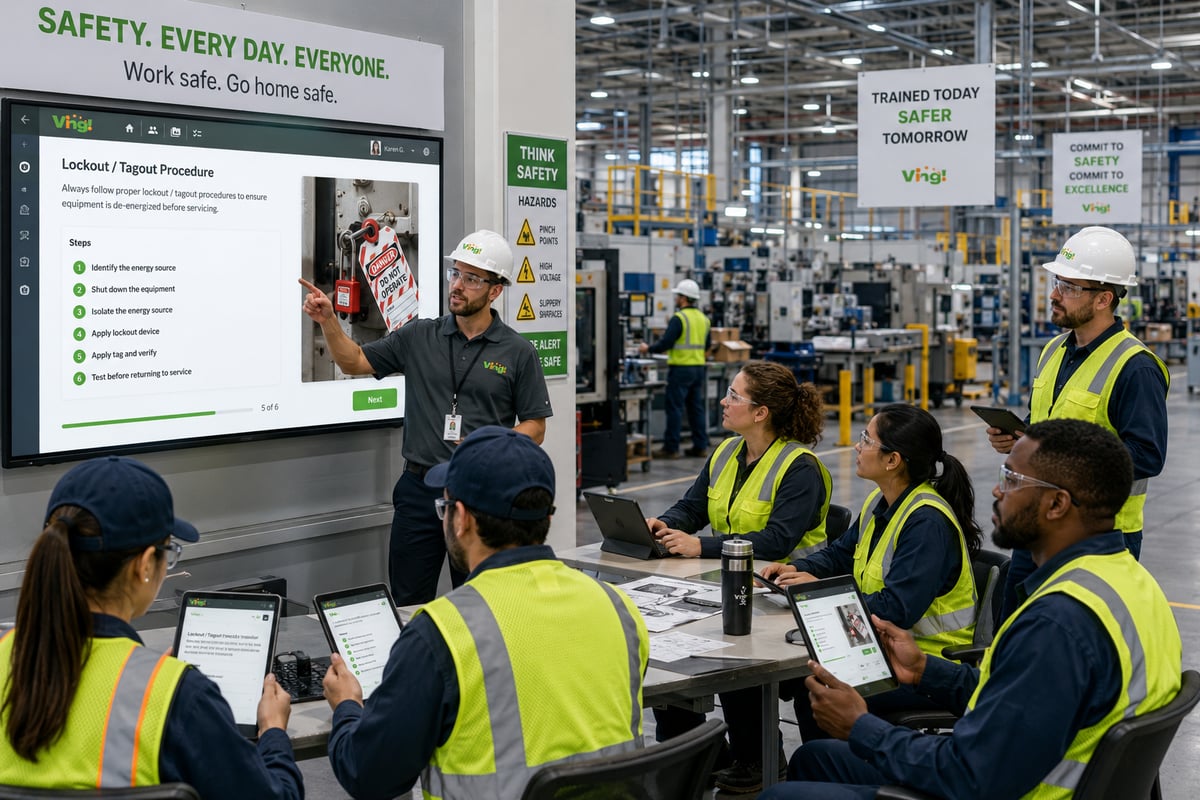
Every minute the production line stops, it costs your facility money. But every safety shortcut taken on that line costs exponentially more.
For Environmental Health and Safety (EHS) directors and plant managers, balancing production quotas with OSHA compliance is a daily tightrope walk. You need a way to train first, second, and third shifts, track machine-specific certifications, and maintain audit-ready records—without pulling operators off the floor for hour-long classroom sessions.
The right software makes this possible. We’ve evaluated the top safety training platforms on the market specifically through the lens of manufacturing. Here is a look at the six best options, depending on your facility's size, IT infrastructure, and compliance needs.

What matters on the factory floor? Evaluating manufacturing safety software
Generic learning management systems (LMS) often fail in manufacturing environments because they assume employees sit at desks. When evaluating software for a plant, warehouse, or multi-site operation, you need tools built for the realities of the floor:
- Shift-agnostic delivery: Can third-shift operators access the same quality of training as the day shift without requiring a supervisor to stay late?
- Frictionless access: Do floor workers have to remember complex passwords to log in, or can they access training via QR codes and SMS during natural breaks?
- Microburst pacing: Can the training be completed in 3 to 5 minutes so it doesn't disrupt production schedules?
- Automated certification tracking: Does the system actively monitor 3-year forklift or lockout/tagout (LOTO) renewals and alert you before they lapse?
- Instant audit reporting: If an OSHA inspector walks into the facility, can you pull a specific employee's complete training history in under two minutes?
Here is how the top platforms approach these challenges.
The 6 Best Safety Training Platforms for Manufacturing
1. Ving: Best for multi-site operations needing agile, mobile-first compliance
The platform built to deliver training without halting production.
Ving is engineered specifically for operations that need to get compliance training into the hands of floor workers with zero friction. Instead of relying on a traditional desktop LMS, Ving pushes microburst training (3-5 minute sessions) directly to employees via SMS, email, or scannable QR codes posted near specific machines.
For EHS directors managing multiple facilities, Ving's centralized dashboard automates the entire lifecycle of compliance. You assign training by role (e.g., all forklift drivers across three plants), and the system handles the delivery, the automated follow-up reminders, and the audit logging.
Standout manufacturing features:
- QR Code & SMS Delivery: Employees can complete a machine-guarding module in the breakroom on their own phones—no logins required.
- 2,000+ OSHA-Aligned Courses: A comprehensive library covering LOTO, hazard communication, PPE, and heavy machinery.
- Automated Expiration Alerts: The system tracks renewal dates for specialized certs and automatically enrolls employees in refresher courses.
- One-Click Audit Reports: Instantly generate compliance logs for internal leadership or external OSHA inspectors.
The Bottom Line: Ving is the ideal solution for EHS teams who want to automate their compliance tracking and deliver training that respects the production schedule.
2. Vector Solutions: Best for large-scale enterprise deployments
A robust, traditional LMS for complex organizational hierarchies.
Vector Solutions (Vector LMS) is a powerhouse in the enterprise learning space. If you are managing a massive, global manufacturing corporation with dedicated training administrators, Vector provides a deeply structured environment. It excels at creating complex, multi-step learning paths that tie into broader corporate HR initiatives.
Standout manufacturing features:
- Deep HR Integrations: Connects seamlessly with enterprise HRIS platforms for automated user provisioning.
- Structured Learning Paths: Administrators can build extensive prerequisite tracks for highly specialized engineering or plant leadership roles.
- Extensive Catalog: A massive library covering everything from basic safety to advanced environmental compliance.
The Bottom Line: Vector is incredibly powerful, making it an excellent choice for large corporations that have the dedicated administrative staff required to implement and manage a full-scale enterprise LMS.
3. J. J. Keller: Best for heavy regulatory and DOT cross-compliance
The industry standard for deep regulatory expertise.
J. J. Keller is widely recognized for its unparalleled expertise in heavy regulations, particularly if your manufacturing operation overlaps with fleet management, transportation, or complex DOT requirements. Their training content is developed by regulatory experts, ensuring every module is strictly by the book.
Standout manufacturing features:
- Expert-Backed Content: Courses are authored and maintained by specialized compliance professionals.
- Regulatory Alerts: Administrators receive direct notifications when state or federal regulations change.
- Documentation Tools: Offers a suite of built-in forms, manuals, and checklists for complete safety program recordkeeping.
The Bottom Line: If your facility’s operations blur the line between manufacturing, warehousing, and transportation—and you need the highest level of strict regulatory documentation—J. J. Keller is a premier choice.
4. HSI: Best for high-production video instruction
A highly visual platform for comprehensive EHS education.
HSI takes a cinematic approach to safety. Their platform relies heavily on high-quality, narrated video courses that walk employees through complex environmental, health, and safety scenarios. This visual format is fantastic for demonstrating intricate safety procedures that require visual comprehension.
Standout manufacturing features:
- High-Quality Video Instruction: Engages visual learners with real-world demonstrations rather than just text and diagrams.
- Broad EHS Scope: Extensive coverage of environmental topics (like chemical spills and emissions) alongside standard worker safety.
- Built-in Assessments: Post-video quizzes designed to thoroughly verify comprehension.
The Bottom Line: HSI is an excellent fit for facilities with strong, reliable Wi-Fi on the shop floor that prefer to train their teams using detailed, visually rich video content.
5. 360training: Best for formal OSHA 10 & 30 Outreach Certifications
An a-la-carte marketplace for official credentialing.
While 360training does offer a business LMS, they shine brightest as a marketplace for formal OSHA outreach training. If you have newly promoted floor supervisors who need their official OSHA 30 card, or specialty workers who require formal HAZWOPER credentials, 360training provides authorized, self-paced courses to get them certified.
Standout manufacturing features:
- DOL Cards: Authorized provider for official Department of Labor completion cards.
- A-la-carte Purchasing: Buy exactly the courses you need for specific employees without necessarily requiring a full platform subscription.
- Self-Paced Deep Dives: Excellent for long-form, multi-hour certification tracks.
The Bottom Line: 360training is the perfect supplementary tool when you need to purchase formal, long-form credentialing for specific members of your plant leadership or specialized hazard teams.
6. SafetySkills: Best for 3D-animated hazard scenarios
An engaging, scenario-based approach to workplace hazards.
SafetySkills takes a unique approach to their content library: their courses are delivered via high-quality 3D animations. This style allows them to safely illustrate dangerous scenarios—like arc flashes or severe machinery malfunctions—without the limitations of live-action footage. It pairs this engaging content with a strong enterprise LMS.
Standout manufacturing features:
- Animated Scenarios: Safely and vividly demonstrates the consequences of safety failures.
- Training Matrices: Allows administrators to upload rules for automatic assignment based on job roles.
- SCORM Compliant: The platform accepts third-party courses if you have existing corporate training you want to migrate.
The Bottom Line: If you find that your workforce tunes out standard live-action safety videos, the distinct, animated approach of SafetySkills offers a highly engaging alternative.
Comparison Table: Manufacturing Safety Software
| Platform | Best Use Case | Primary Delivery Style | Automated Expiration Tracking |
| Ving | Agile, multi-site manufacturing | SMS, QR codes, Microlearning | ✓ |
| Vector Solutions | Large-scale enterprise HR | Comprehensive enterprise LMS | ✓ |
| J. J. Keller | Heavy regulatory & DOT | Deep compliance documentation | ✓ |
| HSI | Visual EHS education | High-production video | ✓ |
| 360training | Formal credentialing | OSHA 10/30 Outreach courses | ✓ |
| SafetySkills | Scenario-based engagement | 3D Animated video courses | ✓ |
Why agile software is the future of manufacturing safety
For decades, manufacturing safety training meant shutting down a line, cramming operators into a breakroom, and putting a DVD on the television.
Modern platforms have changed the equation. By utilizing software like Ving, safety directors can finally separate training from downtime. When an operator can scan a QR code on a forklift, complete a 3-minute refresher course on their phone, and instantly satisfy an OSHA requirement—everybody wins. Production keeps moving, the safety director gets a verified digital record, and the worker stays safe.
Ready to see how agile safety software can transform your plant floor? Schedule a demo of Ving today to see our automated compliance dashboards and mobile-first training in action.
FAQs: Safety Training Software on the Plant Floor
How do we handle training for employees who don't have company email addresses?
This is a common challenge in manufacturing. Platforms built for the floor, like Ving, bypass the need for company emails entirely. Training can be delivered via SMS text messages to personal devices, or accessed through communal tablets using scannable QR codes located at specific workstations.
What is the best way to train employees on 2nd and 3rd shifts?
Automated delivery is the key to shift equity. Instead of requiring a safety manager to be present at 2:00 AM, automated platforms can be scheduled to text a 5-minute training module to the night shift crew exactly 10 minutes before their shift begins.
Can training software help with ISO 45001 or OSHA audits?
Absolutely. The most stressful part of an audit is usually the documentation, not the actual safety practices. Modern safety software centralizes your records, allowing you to instantly pull real-time reports showing exactly who was trained, on what date, covering which specific hazards.
-2.png?width=352&name=Untitled%20design%20(5)-2.png)
Leave a Comment