

You're responsible for safety training at more than one location, and you already know the rules differ from site to site. Federal OSHA standards and OSHA-approved State Plans establish baseline requirements, while your industry, location, and individual customer contracts may add further obligations. Missing an applicable requirement can put workers at risk and create problems during an inspection or audit.
This guide walks you through how to map every training requirement your operation faces, spot the gaps hiding in your current program, and build an audit-ready training matrix that holds up across every site. Ving's safety training platform helps multi-site teams centralize that process, but the framework here works regardless of the tools you use.
By the end, you'll have a clear, repeatable method for helping keep workers trained on the right topics, at the right intervals, with organized records of that training.
This article provides general educational information and is not legal advice. Requirements vary by workplace, jurisdiction, and current law. Review the applicable OSHA standard and State Plan requirements, and consult a qualified safety or legal professional for guidance specific to your organization.
Quick Answer: What Are Safety Training Requirements?
Safety training requirements are the instruction, evaluation, and documentation duties that apply to workers based on their hazards, job tasks, industry, and location. Employers should identify the standards that apply to each role, record completion and retraining triggers in a training matrix, and update that matrix whenever hazards, equipment, processes, or regulations change.
Key Takeaways: Safety Training Requirements
- Training requirements appear throughout applicable OSHA standards rather than in one universal checklist.
- State and industry-specific requirements layer on top of federal mandates, so multi-site teams must track both.
- A training matrix maps every role to every required course, expiration date, and completion status at a glance.
- Ving gives multi-site safety leaders dashboards and reminders designed to help identify overdue and upcoming training.
- Regular gap analyses tied to risk assessments keep your training program aligned as hazards and regulations change.
What Are OSHA Safety Training Requirements?
OSHA does not publish one universal training checklist. Training provisions appear throughout applicable standards in 29 CFR, and the required audience, content, and retraining triggers vary. Your obligations depend on the hazards and work performed at each site.
Common examples include Hazard Communication (29 CFR 1910.1200), which requires effective information and training at initial assignment and when a new chemical hazard employees have not previously been trained about is introduced. Lockout/Tagout (29 CFR 1910.147) requires training for covered employees and retraining when specified changes or knowledge deficiencies occur. Construction employers may face additional requirements under 29 CFR 1926.
When no specific standard applies, OSHA may use the General Duty Clause, Section 5(a)(1) of the OSH Act, for a recognized workplace hazard that is causing or is likely to cause death or serious physical harm when a feasible means of reducing the hazard exists. OSHA's recommended practices for safety and health programs also emphasize education and training as part of an effective safety and health program.
Why Training Requirements Differ Across Sites and Industries
Federal OSHA covers many private-sector workplaces, while OSHA-approved State Plans administer and enforce their own programs for covered workplaces. State Plan standards must be at least as effective as federal OSHA standards and may be different or more stringent. California's Cal/OSHA, for example, has specific heat illness prevention and workplace violence requirements. Multi-state teams should review the rules and jurisdiction that apply at each location.
Industry shapes your obligations too. Construction crews face fall protection training under 29 CFR 1926.503. Manufacturing plants with confined spaces must meet 29 CFR 1910.146. Healthcare and transportation add bloodborne pathogen and DOT hazmat requirements.
Customer and contract requirements may add further expectations. OSHA's 10-Hour and 30-Hour Outreach courses are voluntary under federal OSHA and do not replace training required by specific standards, although some states, employers, unions, organizations, or contractors may require course-completion cards. Insurance carriers may also set training expectations as a coverage condition.
How to Identify Every Training Requirement for Your Operation
Start by listing every role at every site. A maintenance technician at a food processing plant faces different hazards than one at a steel fabrication shop, even with the same title. Hazard exposure drives training obligations, not job descriptions.
Match each role to the hazards at that location. Walk the site, review your OSHA 300 Logs if your organization is required to maintain them, and check your most recent risk assessments. For each identified hazard, review the applicable OSHA or State Plan standards and determine whether they include training, documentation, or other requirements.
Layer in state-specific requirements. Check whether your state operates an OSHA-approved State Plan. California, Washington, Oregon, and Michigan are among the states with significant additions to federal rules. Review customer contracts, insurance policies, and trade association guidelines for any training expectations beyond OSHA.
What Is a Safety Training Matrix?
A safety training matrix maps every employee or role against every required training topic. Each cell shows whether training is complete, upcoming, or overdue, along with expiration dates and refresher intervals.
Rows represent employees or roles. Columns represent training requirements. Every cell tells you the current status. For a 30-person crew, a spreadsheet might hold up. For 200 employees across multiple sites, a static spreadsheet becomes a risk the moment someone forgets to update it.
An effective matrix includes the training topic, applicable regulation, required audience, refresher cadence, last completion date, and next due date. That single view lets you act on gaps before they turn into audit findings.
How to Build an Audit-Ready Training Matrix Step by Step
Step 1: Inventory All Regulatory and Contractual Requirements
Identify potentially applicable training requirements in federal OSHA standards, your State Plan, other industry-specific regulations such as DOT, EPA, or MSHA rules, and contractual obligations. Confirm each requirement's scope, citation, audience, content, and retraining triggers before adding it to your matrix.
Step 2: Map Roles to Requirements
For each job role at each site, mark which training topics apply based on the hazards and work involved. A powered industrial truck operator covered by 29 CFR 1910.178 must receive training and be evaluated as required by that standard. Electrical and laboratory work may trigger additional training requirements based on the tasks and exposures involved. Don't assume one size fits all across sites.
Step 3: Populate Completion and Expiration Data
Pull existing training records for every employee and enter their last completion dates. Calculate the next due date based on the refresher cadence for each requirement. Color-code or flag any cell where the next due date has already passed or falls in the near term. This is where gaps become visible.
Step 4: Assign Ownership and Set Alerts
Assign a responsible person for each site or department to keep the matrix current. Set automated alerts for upcoming expirations. Without clear ownership and proactive reminders, even a well-built matrix goes stale. Ving's compliance tracking dashboards automate this step by flagging overdue and upcoming training assignments in real time.
Step 5: Review and Update on a Regular Cycle
Schedule quarterly reviews of the full matrix. Update it whenever a new hazard is introduced, a regulation changes, a new role is created, or an employee transfers between sites. The matrix is a living document, not a one-time project.
How to Conduct a Safety Training Gap Analysis
A gap analysis compares what training your workforce currently has against what's required. It turns your matrix from a tracking tool into a decision-making tool.
Filter your completed matrix for any cell that's overdue, not recorded, or marked not applicable when it should be required. Group results by site, role, and training topic to spot isolated misses versus systemic patterns.
Cross-reference gaps against your most recent risk assessments. If a site hazard assessment flagged confined space entry but no employees at that site have confined space training on record, that's a safety gap, not just a paperwork issue.
Prioritize by severity and exposure. Missing required powered industrial truck training or evaluation for an active operator may present greater immediate risk than a refresher that is not yet due. Assign corrective actions with deadlines and track them to closure.

Common OSHA Training Requirements by Industry
Construction Industry Training Requirements
Construction employers face some of the most detailed training requirements in 29 CFR 1926. Fall protection training is required under 1926.503 for any worker exposed to fall hazards. Scaffolding training falls under 1926.454. Excavation competent person requirements are in 1926.651 and 1926.652.
These requirements apply at every job site. A general contractor with multiple active projects must verify training compliance for each crew at each location, and records need to follow workers as they move between sites.
Crane and derrick operators must meet qualification requirements under Subpart CC. Electrical safety training for construction is covered in 1926 Subpart K. Every construction site also needs a hazard communication program with site-specific chemical training for all workers.
Manufacturing Industry Training Requirements
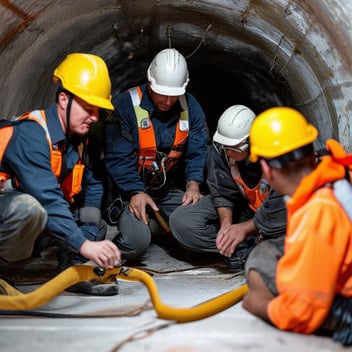
Manufacturing operations typically deal with general industry standards in 29 CFR 1910. Lockout/Tagout (1910.147) training is critical wherever workers service or maintain machines. Machine guarding awareness falls under 1910.212. Permit-required confined space training (1910.146) applies when employees enter tanks, silos, or other enclosed spaces.
Process Safety Management (1910.119) adds another layer for facilities handling highly hazardous chemicals. Noise exposure and hearing conservation training are covered under 1910.95 when employee exposure exceeds the action level.
HVAC and Stone Industry Training Requirements
HVAC employers may need training tied to electrical safety, lockout/tagout, respiratory protection, hazard communication, fall protection, ladders, and refrigerant or chemical exposure. The applicable requirements depend on whether the work occurs in a shop, plant, rooftop, construction site, or customer facility.
Stone fabrication and installation teams may need training for respirable crystalline silica, powered industrial trucks, machine guarding, lockout/tagout, respiratory protection, hearing conservation, and safe material handling. Map each potential requirement to cutting, grinding, polishing, lifting, installation, and field-service tasks, then confirm applicability under the current standards.
How to Keep Your Training Program Aligned with Changing Regulations
OSHA updates standards, states adopt new rules, and industry consensus standards evolve. If your training program is built on a static list from three years ago, you're already behind.
Designate someone to monitor regulatory updates. Subscribe to OSHA's QuickTakes newsletter and your state plan's alert system. Track changes from industry bodies like the American Society of Safety Professionals (ASSP).
When a regulation changes, update your training matrix immediately. Determine which roles are affected, adjust the required content and cadence, and schedule sessions. Document when you updated the program and when employees completed the revised training.
Ving's workplace safety training library is designed to support employee education and training administration. Employers should confirm that selected content, delivery methods, hands-on components, evaluations, and documentation satisfy the requirements that apply to their workers and worksites.
How Risk Assessments Drive Training Requirements
Your risk assessment is the foundation of your training program. OSHA's recommended practices state that education and training are critical tools for informing workers about hazards and controls so they can work more safely. Training requirements flow directly from the hazards you've identified.
Every time you conduct a job hazard analysis, a site safety audit, or a process change review, the results should feed back into your training matrix. New or changed hazards may trigger new or revised training, procedures, controls, or documentation. Confirm the applicable requirements before adding or removing an assignment.
If you're linking risk assessments to training assignments manually, maintaining that connection can be difficult. Centralizing both activities can help teams keep them aligned. Ving's Safety Risk Assessment tool is designed to help teams identify potential training needs based on their industry, location, workforce, and documented risks, then connect identified gaps to relevant content for review.
What to Look for in a Training Compliance Tracking System
A good system can assign training by role and site, track completion status, generate reports that support audit preparation, and send reminders before internally recorded due dates pass.
Role-based assignment lets you group employees by job title, department, or location and assign the right training to each group automatically. This eliminates manual spreadsheet updates whenever someone transfers or a new hire starts.
Dashboards can show who is current, overdue, or approaching a recorded due date. Training reports that support audit preparation can organize records, timestamps, and assessment results for review. The underlying records and their retention periods should still be checked against each applicable requirement.
Automated reminders can support proactive training administration. When the system alerts supervisors before a recorded evaluation, qualification, or refresher date, teams have more time to review the requirement and address potential gaps.
How Multi-Site Teams Can Standardize Safety Training
Start with a shared training matrix covering baseline federal and company requirements. Add site-specific or state-specific layers on top. Every site works from the same framework, even if the details differ.
Centralize your content library so every site accesses the same courses. When you update a course, the update reaches all locations at once. No more version control issues or outdated content floating around a single facility.
Use consistent tracking and reporting everywhere. If one site tracks training on paper and another uses a spreadsheet, you can't get a unified compliance view. A single compliance platform that scales gives every site the same tools and gives leadership a rollup dashboard.
Ving connects training, inspections, and documentation in one platform, helping teams maintain a more consistent operational record across sites.
How to Prepare for a Safety Training Audit
Any audit will ask for documentation that specific employees received specific training on specific dates. If you can't produce that documentation quickly, you have a problem regardless of whether the training happened.
Maintain records appropriate to the applicable standard, which may include the training topic, date, trainer or qualified person's name, attendees, evaluations, and other required information. Recordkeeping obligations and retention periods vary by rule, jurisdiction, and record type.
Run a mock audit at least once a year. Pull a random sample of employee training records. If you can produce everything an auditor would ask for quickly, you're in good shape.
The U.S. Bureau of Labor Statistics reported 2.5 million nonfatal workplace injuries in private industry in 2024. Current training records are your first line of defense against both injuries and citations.
In Conclusion: Mapping Training Requirements Protects Your Workers and Your Organization
Mapping safety training requirements across a multi-site operation is not a one-time project. It's an ongoing process of identifying what's required, tracking who's completed it, closing gaps before they become incidents or citations, and updating your program as regulations and hazards change.
The framework in this guide gives you a repeatable method: catalog every requirement, build a training matrix by role and site, run gap analyses tied to your risk assessments, and maintain audit-ready records at all times. Whether you manage two sites or two hundred, the approach is the same.

FAQs About Safety Training Requirements
What is a safety training requirements matrix?
A safety training requirements matrix is a grid that maps job roles against required training topics, showing completion status and expiration dates for each employee. It gives you a single view of who needs what training, who's current, and where gaps exist across your workforce.
How do you identify which OSHA training requirements apply?
Start by identifying the hazards and work activities present at each site. Review the potentially applicable OSHA standards and determine whether they include training, qualification, evaluation, documentation, or other requirements. An OSHA-approved State Plan may impose different or additional requirements depending on your location.
How often should safety training be renewed?
Retraining and evaluation triggers vary by standard. Under 29 CFR 1910.178, each powered industrial truck operator's performance must be evaluated at least once every three years, with refresher training and evaluation also required in specified circumstances. Hazard Communication training is required at initial assignment and whenever a new chemical hazard employees have not previously been trained about is introduced. Check the current standard and any applicable State Plan rule.
How does Ving help with safety training compliance tracking?
Ving provides training-status dashboards by employee, role, and site, along with reminders based on the dates recorded in the system. Its workplace safety content and reporting tools are designed to help teams organize training records and prepare information for review. Employers remain responsible for determining which requirements apply and whether their training program satisfies them.
What is a safety training gap analysis?
A safety training gap analysis compares current training records against the requirements your organization has identified. It can help identify missing assignments, overdue refreshers, or training that may need review after a new hazard is identified. Ving's training tracking tools can help organize this analysis.
Can you standardize safety training across multiple locations?
Yes. Build a baseline training matrix covering applicable federal and company-wide requirements, then add State Plan, local, contractual, and site-specific layers. A centralized platform like Ving can help deliver consistent content, track completion from one dashboard, and manage content updates across locations.

Leave a Comment