
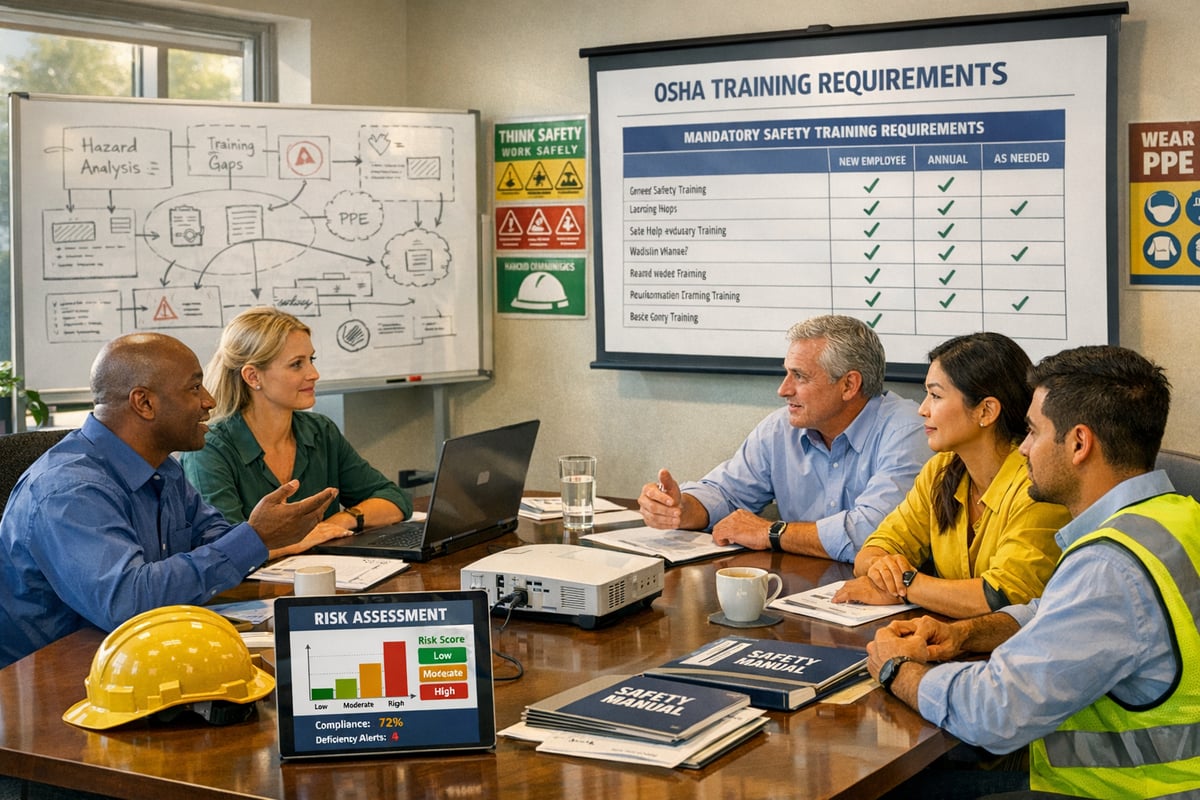
Missing an OSHA training requirement can create real exposure for your business, from citations and fines to preventable incidents and weak documentation. The best way to find those gaps is to start with your actual workplace hazards, connect them to the standards that apply, and compare those requirements against your current training records.
If you want a faster way to do that, Ving’s Safety Risk Assessment gives you a practical starting point. You enter your industry, operating states, company size, and optionally your website, and the online assessment cross-references your profile against OSHA, EPA, DOT, NFPA, and state-level requirements to return required training, risk scores, financial exposure, and direct regulatory citations.
Start your free Safety Risk Assessment here.
Who This Is For
This guide is for safety leaders who need a clearer way to identify training requirements and close compliance gaps, including:
- Safety Directors
- EHS Managers
- Compliance Managers
- Operations leaders responsible for workforce safety
- Multi-site teams that need more consistency in training decisions
It is especially useful if you are adding locations, hiring quickly, changing equipment, expanding into new states, or preparing for an OSHA inspection.
Key Takeaways
- OSHA training gaps happen when workplace hazards exist but required training has not been assigned, completed, updated, or documented.
- A structured risk assessment helps connect those hazards to the training standards that apply to your workforce.
- Ving’s Safety Risk Assessment helps you identify likely training requirements based on your company profile and operating footprint.
- The results can help you prioritize risk, support documentation, and decide what training to assign next.
- After identifying gaps, the next move is turning findings into training assignments, tracking, and recordkeeping.

What Is a Safety Risk Assessment and Why Does It Matter for Training?
A safety risk assessment is the process of identifying workplace hazards, evaluating the risks they create, and determining which controls are needed to reduce those risks. Training is one of those controls.
That matters because OSHA training requirements are tied to real hazards. If workers are exposed to fall hazards, hazardous chemicals, energy isolation, powered industrial trucks, confined spaces, or other regulated risks, training becomes part of your compliance responsibility. A risk assessment helps you identify those exposures and connect them to the training your team needs.
This is one of the most effective ways to find hidden training gaps because it shifts the question from “What training do we usually assign?” to “What hazards do our workers actually face, and what training does that trigger?”
How OSHA Training Requirements Connect to Workplace Hazards
OSHA does not require training for the sake of training. Training requirements are tied to specific tasks, environments, and exposures.
A few common examples include:
- Fall hazards can trigger fall protection training
- Hazardous chemical exposure can trigger hazard communication training
- Powered industrial truck use can trigger forklift operator training and evaluation
- Energy isolation tasks can trigger lockout/tagout training
- Noise exposure can trigger hearing conservation training
Once you identify the hazard, you can start building a more accurate training requirement list. That is why risk assessment is such a useful first step.
Why Generic Safety Training Often Leaves Gaps
Broad safety training can help with awareness, but it does not always reflect the specific conditions workers face every day. A roofing crew, a manufacturing floor, and a distributed field team may all need very different training coverage.
A risk-based approach is stronger because it starts with the work itself: tasks, materials, equipment, locations, and exposures. From there, you can match those conditions to the standards that apply.
That gives you a more useful answer than a generic course list. It also helps you avoid overtraining some workers while missing critical training for others.
Step-by-Step Guide to Finding OSHA Training Gaps
The process is straightforward:
- Identify hazards
- Match hazards to training requirements
- Compare those requirements against current training records
- Prioritize the gaps
- Assign and track corrective action
Here is how to work through it.
Step 1: Gather Existing Hazard Information
Start with the information you already have, including:
- Job hazard analyses (JHAs)
- Incident and near-miss reports
- Workers’ compensation records
- OSHA 300 logs
- Safety Data Sheets
- Equipment manuals
- Inspection reports
- Internal audit findings
These records help build your starting hazard inventory and often reveal where training breakdowns may already exist.
Step 2: Review the Work Being Done
Next, look at how work is actually performed. Records help, but they do not capture everything.
Focus on areas like:
- Work at height
- Equipment operation
- Electrical exposure
- Chemical handling
- Heat stress
- Noise exposure
- Ergonomic strain
- Vehicle movement
- Fire and emergency response issues
If your teams work across multiple job sites, shifts, or states, this review becomes even more important.
Step 3: Identify Hazard-Specific Training Requirements
Once hazards are identified, connect each one to the applicable standard and training requirement.
A simple matrix can help:
- Hazard: Work at heights above 6 feet
Standard: 29 CFR 1926.503
Training: Fall protection training - Hazard: Exposure to hazardous chemicals
Standard: 29 CFR 1910.1200
Training: Hazard communication training - Hazard: Use of powered industrial trucks
Standard: 29 CFR 1910.178
Training: Forklift operator training and evaluation
This process turns hazard identification into a practical training checklist. If you already know the gaps you need to close, this is also the point where it makes sense to connect findings to your broader training resources.
Step 4: Compare Requirements to Current Training Records
Now compare your required training list against what employees have actually completed.
Look for three common issues:
- Missing training: Required training is not assigned at all
- Incomplete coverage: Some affected workers are trained, but others are not
- Expired or outdated training: Training was completed, but refreshers or evaluations are overdue
This is where many teams discover that the content exists, but the assignment, timing, or documentation does not fully match the risk.
Step 5: Prioritize the Highest-Risk Gaps First
Not every gap carries the same urgency. Prioritize based on:
- Severity of potential harm
- Likelihood of exposure
- Number of workers affected
- Frequency of the task
- Regulatory and financial exposure
For example, a missing forklift qualification for an active operator usually needs faster action than a lower-frequency administrative topic.
How Ving’s Safety Risk Assessment Helps You Find Training Gaps Faster
If you want to speed up the front end of this process, Ving’s Safety Risk Assessment is built to help.
1. Enter Your Company Details
Add your industry, operating states, and company size. You can also include your website for more tailored results.
2. Cross-Reference Regulatory Requirements
The assessment reviews your profile against federal OSHA standards, EPA requirements, DOT rules, NFPA codes, and state-level safety requirements. If you include your website, it can use your public pages to identify likely roles, work activities, and equipment that may affect training needs.
3. Get a Tailored Risk Report
The report is designed to give you useful next steps. It can include:
- Required training topics
- Risk scores
- Estimated financial exposure
- Mandatory, conditional, and recommended items
- Direct regulatory citations tied to the findings
That helps move your team from general concern to a more actionable list of likely requirements.
Why This Digital Workflow Works Well for Safety Teams
A digital assessment helps in a few important ways.
Faster Discovery
Instead of building everything from scratch, you get a structured view of likely requirements based on your footprint and company profile.
Better Prioritization
Risk scores and financial exposure help you decide where to focus first.
Stronger Documentation
Direct citations give your team a clearer starting point for internal review, follow-up, and audit preparation.
The goal is not to replace internal safety judgment. It is to give your team a faster, more organized way to identify likely requirements and move into action.
What to Do After You Identify Training Gaps
Finding gaps only matters if you act on them. Once you know where the exposure is, the next step is making the response operational.
Assign the Right Training to the Right Workers
Each gap should turn into a clear action plan:
- Which workers are affected
- What training they need
- When they need to complete it
- Whether comprehension needs to be verified
- Whether recurring reminders or retraining are needed
If you need to support site-specific or role-specific needs after the assessment, this is also where related resources can help.
Track Completion and Keep Records Ready
Your follow-up process should make it easy to confirm:
- Who has completed training
- What was assigned
- When it was completed
- Whether certifications are current
- Whether records are accessible during an inspection or audit
This is where Ving’s broader platform can support the next phase. After the assessment identifies likely gaps, teams can move into training delivery, completion tracking, reminders, dashboards, and certification monitoring.
For teams that also use short-format reinforcement content, you can support ongoing awareness between formal assignments as well.
Common OSHA Training Gaps Risk Assessments Often Uncover
Every workplace is different, but some issues show up often.
Construction
- Fall protection training that is too general for the actual task
- Incomplete scaffolding training documentation
- Gaps in trenching and excavation training
- Missing competent person-related documentation
Manufacturing
- Machine-specific lockout/tagout gaps
- Incomplete forklift evaluation records
- Chemical handling training gaps
- Missing refresher training tied to process changes
General Industry
- Hazard communication updates not tied to new chemicals
- Emergency action plan training that happened once and was never reinforced
- Hearing conservation gaps where exposure levels changed
- Incomplete documentation for recurring required topics
How to Keep Your Assessment Process Audit-Ready
If OSHA asks how you determined training needs, your process should be clear and documented.
Keep records of:
- Hazard inventories
- Assessment findings
- Applicable standards
- Training requirement mapping
- Training assignments
- Completion records
- Refresher schedules
- Supporting citations and source material
The goal is not just to deliver training. The goal is to show that your training decisions are tied to real hazards, current requirements, and documented follow-up.
Conclusion: Turn Risk Findings Into Action
The most reliable way to find OSHA training gaps is to connect hazards to the training requirements that apply to them, then compare those requirements against what your workforce has completed.
You can do that manually, but a digital workflow makes the process faster and more consistent. Ving’s Safety Risk Assessment helps you identify likely training requirements based on your industry, states, company profile, and public-facing details, then returns a report with risk scores, financial exposure, and direct regulatory citations so your team can act with more clarity.
If you are ready to get a clearer picture of your training requirements and compliance exposure, start here:
Try the free Safety Risk Assessment: https://safety-risk-assessment.lovable.app/
From there, you can move into training assignment, tracking, reminders, and audit-ready documentation with a stronger foundation.
FAQs About OSHA Training Gaps and Risk Assessments
What is an OSHA training gap?
An OSHA training gap is the difference between the training workers are required to have based on their hazards and the training they have actually completed. If a hazard exists and the related training is missing, incomplete, outdated, or undocumented, that is a gap.
How do you identify training gaps in a risk assessment?
You identify training gaps by listing workplace hazards, matching them to the standards and training requirements that apply, and comparing those requirements against current training records. That shows what is missing, incomplete, or overdue.
What does Ving’s Safety Risk Assessment do?
Ving’s Safety Risk Assessment helps you identify likely safety training requirements based on your industry, operating states, company size, and optionally your website. It cross-references that information against OSHA, EPA, DOT, NFPA, and state-level requirements and returns a report with required training, risk scores, financial exposure, and regulatory citations.
Is the assessment a replacement for internal safety review?
No. It is a structured digital starting point for identifying likely requirements and prioritizing follow-up. Your internal team should still review the findings against actual site conditions, work practices, and workforce exposure.
What should I do after finding training gaps?
After identifying gaps, assign the required training to affected workers, set deadlines, track completion, monitor expirations, and keep records accessible. The faster you move from findings to follow-up, the more useful the assessment becomes.
Can I use the assessment before I am ready to buy anything?
Yes. The Safety Risk Assessment is free to start and does not require a credit card. It gives you a practical way to understand likely requirements and decide on next steps.
-3.jpg?width=352&name=blog%20image%20(3)-3.jpg)

Leave a Comment